Allied health | Healthcare science | Research | Career Development and Education
Meet the Pharmacists Shaping the Future of Healthcare at UHS
Every day, pharmacists help make some of healthcare's most important decisions.
From ensuring medicines are safe and effective to leading specialist clinics, supporting research and helping patients manage complex conditions, pharmacists play a crucial role in delivering outstanding care.
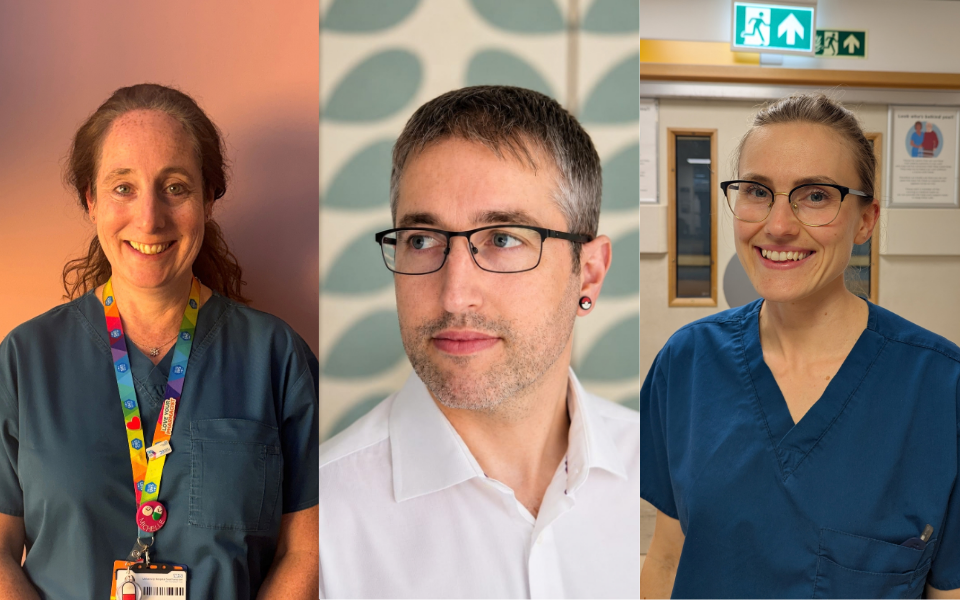
This World Pharmacists Day, we're celebrating the pharmacy professionals at UHS whose expertise, dedication and innovation make a difference to patients and colleagues every day. We spoke to three pharmacists, Michelle(Left), Matthew (Middle) and Esther (Right) about their career journeys, the opportunities that have shaped them and what inspires them most about their roles. Their stories reveal the breadth of modern pharmacy, and the impact pharmacists have far beyond what many people expect.
Thinking back to the start of your career, what inspired you to pursue pharmacy?
Michelle, Divisional Lead Pharmacist for Cardiovascular and Thoracic, and Neuro: I didn’t apply for a pharmacy degree initially but fell into it through clearing at Cardiff University after talking to a family friend who was a pharmacist. That friend turned out to be a colleague I would work closely with in later years!
I quickly realised though that pharmacy was a good fit for me. I was inspired by one of the university teacher-practitioners and knew that hospital pharmacy was where I wanted to work. After my degree I completed my trainee year in a district general hospital near my home in the Cotswolds, but I knew I wanted to work in a larger hospital, so started as a junior pharmacist in Portsmouth; later moving to Southampton to pursue my interest in cardiology.
Matthew, Lead Pharmacist for Neurosciences and Specialist Pharmacist in Migraine: Like many pharmacists, I did not grow up knowing that I wanted to work in pharmacy. I enjoyed science at school but had no clear career or profession in mind. After a visit to our local pharmacy, my mother suggested that I consider working there. I applied for a job as a counter assistant at Lloyds Pharmacy, was successful at interview, and that was my introduction to the profession.
Esther, Specialist Pharmacist for Gastroenterology and Biologics: Before I started the pharmacy degree, I wanted to be involved with drug discovery (something along the lines of exploring the rainforest). I was really inspired by a mental health pharmacist who was my tutor at university, so from that point I adjusted my vision to working in a hospital. I wanted to be involved directly in patient care and to be in a career that encourages lifelong learning.
Pharmacy offers many different career paths. What opportunities have helped shape your journey so far, and where do you hope your career will take you next?
Michelle: My early years in Portsmouth really shaped my career today as I gained experience in multiple specialities, but most notably respiratory, general medicine, psychiatry, renal and cardiology. Working with the specialist renal pharmacist was probably one of the most useful experiences I still use today.
I love to teach other healthcare professionals and have been fortunate to be able to combine my interest in cardiology with a role as an education and training pharmacist both in Portsmouth and later in Southampton. Running the Postgraduate Diploma in Clinical Pharmacy with the University of Portsmouth was very rewarding and kept my clinical knowledge up to date on a wide range of subjects. My role now as lead pharmacist for cardiovascular and thoracic (CV&T) means I am still able to be involved in education and training for the wider healthcare team, and I hope one day that I can become a consultant pharmacist for cardiology.
Matthew: I did not take a typical route to becoming a pharmacist. I started as a counter assistant at Lloyds Pharmacy before moving to Poole Hospital as a dispensing assistant. From there, I trained as a pharmacy technician and later became an accredited checking technician.
The biggest opportunity in my career came when I completed an Access to Higher Education course at Weymouth College, which gave me the entry requirements I needed to study pharmacy at university. I had not followed a straightforward academic route at school, so without that opportunity I would not be where I am today.
I graduated with a first-class Master of Pharmacy (MPharm) degree in 2016 and completed my pre-registration training at UHS. Since then, I have worked across a range of clinical areas before specialising in neurosciences and headache and progressing to my current role as lead pharmacist for neurosciences and specialist pharmacist in migraine. Over the course of my career, I have worked at every band from Band 2 through to Band 8.
More recently, I have completed a Master’s in Clinical and Health Research. Looking ahead, I would like the next stage of my career to combine specialist clinical practice, research and service development, potentially progressing towards a consultant pharmacist role.
Esther: The degree I took had lots of opportunities to do placements in hospitals, and I really wanted to be part of the NHS. I started as rotational pharmacist at UHS, 11 years ago, and since then there have been lots of opportunities to specialise in different clinical areas. I have been a specialist pharmacist in gastroenterology, ophthalmology and immunology. There have also always been opportunities to do teaching, supervising, team-leading and to collaborate on projects with academics at the university. I hope to continue on the pathway into research and my goal is to complete a PhD.
How have you been able to contribute to research, innovation, service improvement, or education during your career, and why is this important to you?
Michelle: Innovation and service development are really important to me, and I am continually looking to improve the way we deliver pharmaceutical care to CV&T patients. My MSc research project looked at speeding up discharge from hospital (which is still very relevant today) and my team also won the We Are UHS poster award for innovative ways of working, which sits proudly on my desk. Patient safety is a key part of my role, and I’ve contributed to numerous service development and audit projects to improve the management of patients prescribed anticoagulation and amiodarone as two examples.
Matthew: I have been fortunate to have opportunities to contribute to research, service improvement and education throughout my career. I have just completed a Master’s in Clinical and Health Research, which has allowed me to develop my research skills alongside my clinical role. I have been involved in a number of research projects and publications, particularly around migraine and medicines optimisation.
Service improvement is also a large part of my role. I have helped develop and redesign services within neurosciences, including pharmacist-led migraine clinics, new treatment pathways and initiatives aimed at improving how patients access and receive their medicines.
Education is another area I particularly enjoy. I regularly teach pharmacists and other healthcare professionals, contribute to national educational programmes and support the development of colleagues within pharmacy.
These areas are important to me because they allow pharmacists to influence patient care beyond the individual patient in front of us. Research helps us understand what works, service improvement helps us put that evidence into practice, and education helps spread that knowledge more widely.
Esther: The training pathway as a newly qualified pharmacist means that audit and service improvement are integrated into our job description. I have been able to work with lots of different teams on projects including the managed care department, the medicines safety team and specialist clinical teams. I currently have funding through a programme called Launchpad which means that I can study a Master of Research module and have time to complete a project as part of my working hours. This is important to drive improvements in patient care and to have opportunities to share this learning.
What's something about your role that people are often surprised to learn pharmacists do?
Michelle: When I tell people that I’m a pharmacist I think they are often surprised to hear that I spend very little time in a dispensary and most of my time on wards. Contributing to daily consultant ward rounds is an extremely rewarding part of my role. I also work with the cardiac physiologists and consultant cardiologists to provide a multidisciplinary service for hypertrophic obstructive cardiomyopathy patients, prescribing an expensive drug for eligible patients which requires genetic testing first. Working as part of a multidisciplinary team is something I love about UHS and probably one of our biggest strengths.
Matthew: People are often surprised by the level of clinical responsibility and autonomy pharmacists can have. Many still picture pharmacists mainly working in a dispensary, but in hospital we work directly with patients and alongside the wider clinical team on the wards.
In my own role, I independently prescribe medicines, make treatment decisions and run specialist migraine clinics. Pharmacists are now increasingly involved in assessing patients, prescribing, monitoring and managing treatment, rather than simply supplying medicines.
Esther: Specialist pharmacists have a really important role in managing medicines for people with chronic disease. Sometimes medicines are not accessible because of their cost, or because there has not been much testing in people with a particular illness or disease. A key role for pharmacists is finding ways to ensure patients can use these medicines, which involves looking at alternative funding sources and carefully assessing the sometimes-limited evidence available.
What qualities or skills do you think make someone thrive as a pharmacist, particularly in today's healthcare environment?
Michelle: As a pharmacist you need to have an extremely good eye for detail and be a good team player. I work closely with nurses, doctors and other pharmacy staff every day so you must be approachable, friendly and helpful to everyone. Patient safety is at the heart of what you do so no matter how busy you are it is essential to remain focussed to ensure prescribing is safe for the patient.
Pharmacists are medicines experts, so we need to be accessible and visible to support medicines use. I try to be a good role model for junior members of my team and the wider department and am always happy to get involved to ensure the best outcome for the patient. I also think appropriate communication is extremely important as everyone is so busy these days.
Matthew: I think an enquiring mind is really important. A lot of clinical pharmacy involves understanding why a particular decision has been made, looking at the information available and working out the best course of action for the patient.
Attention to detail is also essential. Pharmacists are often the final clinical check before a medicine reaches a patient, so being able to spot inconsistencies, identify potential problems and question things that do not quite make sense is a key part of the role.
Being comfortable with technology is increasingly important too. We work across multiple electronic systems and need to be able to find, interpret and use information efficiently. Finally, I think being approachable, knowledgeable and helpful makes a huge difference. You want colleagues to feel comfortable coming to you for advice and to see pharmacy as a useful part of the clinical team, rather than only involving us when something has gone wrong.
Esther: To be a hospital pharmacist, it is important to enjoy working in a team with professionals who all have the same goal of putting patients first. Polypharmacy, where people are taking a high number of medicines, is increasing and it is important for pharmacists to have excellent attention to detail to ensure that all medicines are being prescribed and taken appropriately. This also means having a holistic approach and considering how lifestyle and beliefs can influence people’s decisions about their medicines.
If you could invite the public to spend one day in your shoes, what part of your role do you think would surprise or inspire them the most?
Michelle: If you spent a day with me, I think you would be surprised to see how much I juggle at the same time. My clinical role is the part of my job that I enjoy the most, but I also directly manage nine pharmacists and am the divisional pharmacist for CV&T and Neuro, therefore I must be as efficient as possible. Working part time means that there are never enough hours in the day to do everything that I need to do. I hope I inspire others to find a clinical area that you love and to work hard to develop the pharmacy service for patients and the staff that work within your team. Looking back now I wouldn’t want to do any other career.
Matthew: I think the biggest surprise would be the sheer variety within my own role. On any given day I might be reviewing patients on a ward, running a specialist migraine clinic, prescribing medicines, working on a service improvement project, teaching other healthcare professionals or contributing to work outside the Trust.
That variety reflects how broad pharmacy has become. Pharmacists can now be found across the healthcare system: providing Pharmacy First services in the community, running hypertension and other long-term condition clinics in GP practices, prescribing and managing complex treatments in hospitals, working in research and the pharmaceutical industry, and contributing to national organisations such as NICE (National Institute for Health and Care Excellence) and GIRFT (Getting It Right First Time).
What I think is most inspiring is that there is no single pharmacy career path. The profession gives you the opportunity to develop in very different directions depending on your interests.
Esther: Each day is very varied; I work in both an outpatient department and on inpatients wards. However, I also spend lots of my time teaching within the pharmacy department and to other healthcare professionals around the hospital and at the university. I am passionate about helping others to become safe prescribers and really enjoy this aspect of my job.
The experiences shared by Michelle, Matthew and Esther demonstrate the many ways pharmacists make a difference, from improving patient safety and leading research to developing services and supporting colleagues across the NHS. Their stories highlight not only the impact of the profession, but also the diverse and rewarding career opportunities pharmacy can offer.
If their stories have inspired you to consider your own path in pharmacy, why not take the next step? Explore our open opportunities and discover how you could help shape the future of healthcare through innovation, expertise and compassionate patient care.
Click here explore our current vacancies.
Related Blogs
The Career She Always Wanted, Just Not the Way She Expected: Kim's HCSW Career Journey
More
The People Behind the Bypass: Helen on Perfusion, Pressure and Career Progression
More
From Ward Life to Hidden Science: How Amelia Found Her Place Behind the Scenes
More